
A colleague walks into the office beaming in the morning; a job applicant sits down with a smile during their interview; a sales assistant greets their customer in high spirits. A positive attitude is a key to success. But why is this the case, and how can job applicants, employees and managers make the most of it?
Being in a good mood makes you likeable
In a job interview, it’s all about the first impression. More than any words spoken, non-verbal communication influences the decision for or against a candidate. If the candidate is in good spirits, this makes the interviewer feel more favourably towards them and, ideally, reinforces the positive impression made by what they say.
The psychologist Chris Robert (University of Missouri–Columbia), for example, has conducted extensive research into the topic of „humour in the workplace“ and has concluded, amongst other things, that: Cheerful people who spread optimism at work greatly enhance their standing within the company; colleagues and line managers are more likely to remember them, and they are recommended more often than others. – An invaluable advantage for job applicants in any interview.
A positive atmosphere also makes companies attractive
In a study, researchers Adrian Gostick and Scott Christopher surveyed more than a million employees to find out what motivates them and what makes an employer attractive. One of the key findings: people like companies all the more when there is frequent laughter in the workplace. So, fellow HR professionals: during a job interview, it’s not just the candidate’s good humour and positive attitude that matter.
People in a good mood are more productive
University of Toronto. Psychologist Adam Keith Anderson studied three groups of participants: the first group was put in a good mood by listening to music. The second group was played sad music, whilst the control group was given something to read about geographical facts. The participants then completed a series of tasks. The first group, which had previously been put in a good mood, showed significantly better results in terms of their ability to absorb and analyse information.
Not least because of the many positive effects, the role of „Feel Good Manager“ has been around for a few years now, including in some German companies. This is because an employee’s attitude – which, of course, depends not only on their own good mood but also on their colleagues, the working atmosphere and so on – has a direct impact on their performance.
But you can’t just be in a good mood all the time, can you?
That’s true, but it isn’t necessary either. What matters is the proportion of positive thoughts: scientists Barbara L. Fredrickson and Marcial Losada from the University of Carolina have calculated that a positive ratio of at least 3:1 – that is, three positive feelings to every negative one – is sufficient for a positive outlook. And how can you increase the proportion of positive thoughts, if necessary?
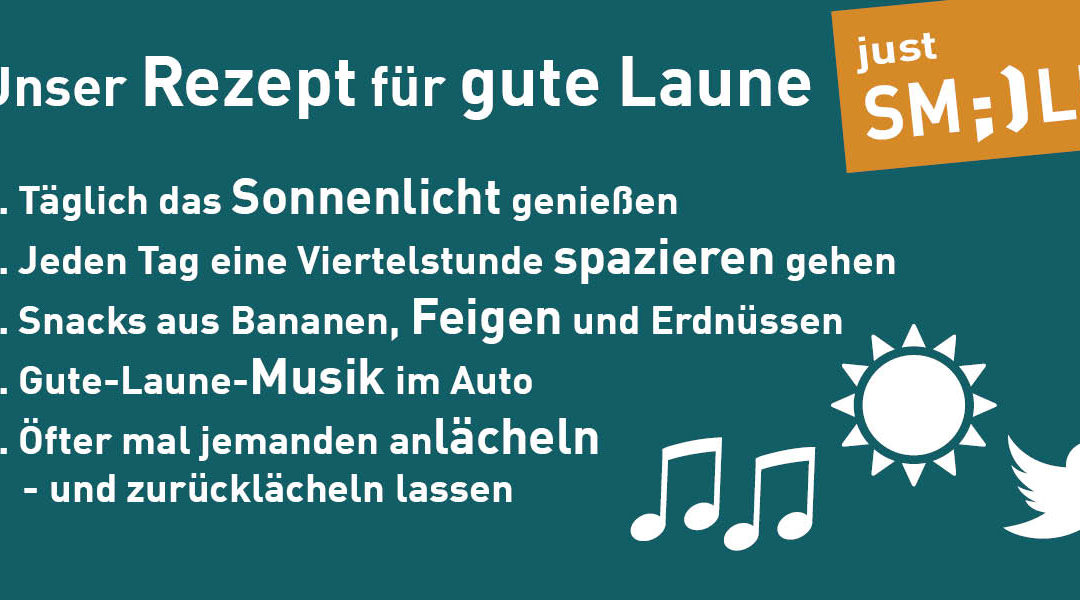
It has been proven that regular exercise and sport stimulate the release of „happiness hormones“ such as serotonin and endorphins. Daylight and sunlight also help to boost your mood. Certain foods also boost your mood, particularly those with a high content of the amino acid tryptophan. These include, for example, bananas, avocados, figs, porridge, Parmesan and various nuts. And (the right) music also has a positive effect.
Oh, by the way, here’s some more good news for anyone who’s not in a good mood today:
In Anderson’s Toronto study mentioned above, it emerged that the bad-tempered participants in Group 2 (sad music) performed better in the concentration test and were less easily distracted whilst carrying out simple, repetitive tasks. So if you’re in a bad mood today, why not try doing something monotonous, such as filing in the office or taking stock?.
And once you’ve successfully completed this highly focused task, why not take part in our competition on Facebook (from 10 January to 15 January 2017, 8 pm) to enjoy some more music and keep the good mood going.
 German
  English
  French
  Spanish
  Italian
  Turkish
  Russian
  Czech
Czech  Polish
  Hungarian
  Romanian
  Croatian
  Portuguese