
The economy, society, politics – we can all look back on two gruelling years: many months of perseverance, of hoping for things to get better, and of ever-changing regulations. This has taken its toll, including on the temporary work sector. As early as April 2021, *The New York Times* coined a term for this: „Languishing“.
At least there are some rays of hope: according to the latest forecasts from the ifo Institute, next year is set to be better.
- Gross domestic product (GDP) is set to rise by 2.5 per cent in 2021,
- Growth of as much as 3.7 per cent is even expected in 2022.
- Everyone involved is hoping that the supply bottlenecks will be resolved and that Germany will be able to make up for the lost growth.
The economic survey conducted by the IW (Institute of German Economy) also reflects this general sense of confidence: of the more than 2,800 companies surveyed, almost half expect turnover to rise in 2022, whilst only 15 per cent anticipate a decline. The manufacturing and services sectors are particularly optimistic. In Baden-Württemberg and Bavaria, the federal states with a strong automotive industry, production expectations for 2022 are particularly high.
Yet global supply chain bottlenecks continue to dominate our day-to-day work; semiconductors and raw materials are not reaching companies in Europe. Global freight logistics continues to suffer from disruptions because ports are being closed due to COVID-19 infections, containers are not where they are needed, or ships are unable to set sail due to staff shortages.
Despite disrupted supply chains: companies are sticking to just-in-time production
The experiences of recent months have done nothing to change this: most companies want to stick to „just-in-time“ stock management. According to economists at the credit insurer Euler Hermes in their latest global trade study, anything else is simply too costly.
As a temporary employment agency, we manage to strike a balance: on the one hand, we supply sectors such as the automotive industry, which have been severely affected by supply bottlenecks due to the chip crisis and are therefore sometimes forced to halt production at short notice. On the other hand, the sectors are experiencing Logistics and Retail a veritable boom with a high demand for labour.
The government is seeking to mitigate the economic imbalance between sectors and its resulting consequences: the short-time working scheme has been extended until March 2022, including short-time working for temporary agency workers.
Short-time working alongside labour and skills shortages
Yet we are facing a severe labour and skilled-worker shortage across Germany. This is already hampering 43 per cent of businesses, as recently reported by KfW (Kreditanstalt für Wiederaufbau) and the ifo Institute in their Skilled Labour Barometer for the fourth quarter of 2021. In the summer of 2021, the figure stood at 23.7 per cent. This means that the shortage of skilled workers and labour is already greater than initially expected.
Temporary work remains an important labour market tool for the German economy: we recruit staff so that our clients are able to fill staffing gaps and make the most of periods of growth. But this is difficult when there is a shortage of candidates.
Open up the Skilled Workers Immigration Act to the temporary work sector
Together with the IGZ and numerous economic institutes, we are therefore calling for the Skilled Labour Immigration Act, passed in 2019, to be extended to cover temporary work. At present, temporary work agencies are not permitted to recruit skilled workers with traditional vocational training from outside the EU. Within the EU, SYNERGIE is helping to address this issue through Global Cross Sourcing: with over 750 branches worldwide, the SYNERGIE Group recruits workers from other European countries for the German market. People changing careers are just as welcome at SYNERGIE as the over-50s, people from migrant backgrounds or those returning to the labour market.
These are all major challenges for the new year, but SYNERGIE and the industry have already demonstrated in 2021 that they are resilient and capable of responding flexibly. Let’s make the most of the quiet period between Christmas and New Year, recharge our batteries for 2022, and hope that next year the New York Times will capture the mood of us all with a positive word.
I wish you all a Merry Christmas and a Happy New Year 2022.
Source:
https://www.ifo.de/node/67010
https://www.iwd.de/artikel/konjunkturprognose-hoffen-auf-2022-530055/
https://www.eulerhermes.de/presse/pressemitteilungen/studie-zum-welthandel-tauziehen-um-waren-deutschland-im-hintertreffen.html
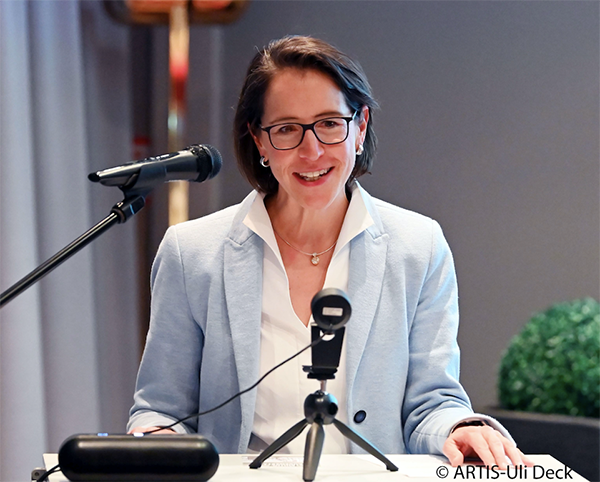
Photo: ARTIS – Uli Deck
 German
  English
  French
  Spanish
  Italian
  Turkish
  Russian
  Czech
Czech  Polish
  Hungarian
  Romanian
  Croatian
  Portuguese