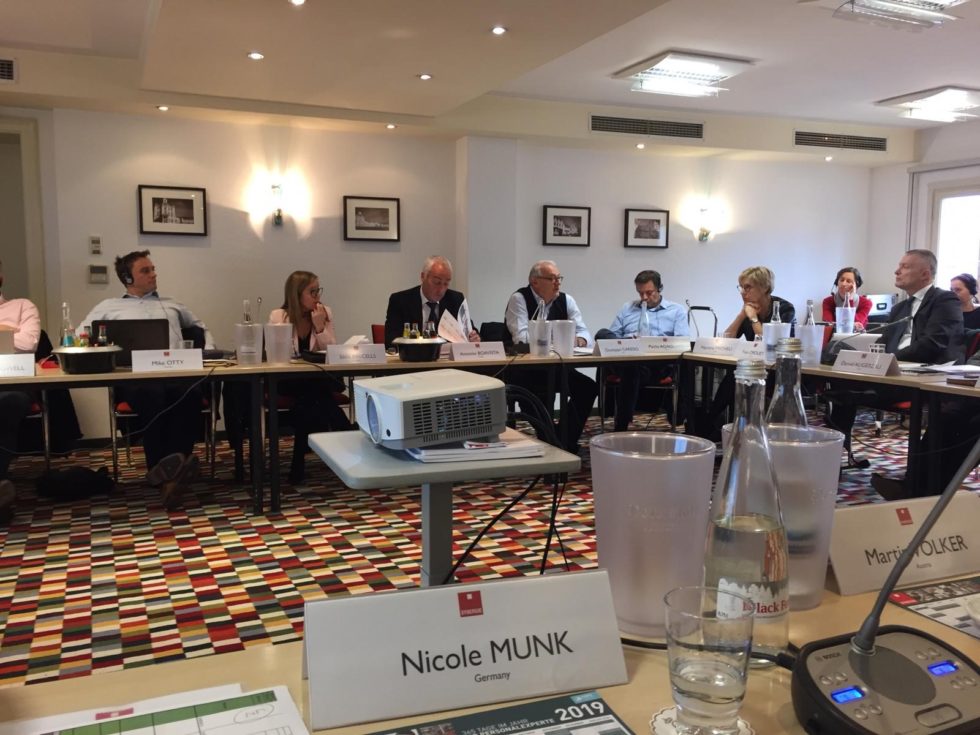
The managing directors from the 16 SYNERGIE countries met last week for an international meeting in Germany. Twice a year, they discuss current issues with representatives of the SYNERGIE Group France.
Among those present this year, both as a host and a participant, was Nicole Munk, Managing Director of the German branch of SYNERGIE. We spoke to her and gained some fascinating insights.
Nicole Munk, can you give us an idea of what an international meeting like this is like? What happens there?
The meetings take place regularly twice a year at different venues to discuss the current situation within the group, Recruitment strategies, to discuss major national clients, as well as sales targets and other developments.
Best-practice examples from the individual countries and, indeed, personal exchanges with one another always play a major role in this.
Ms Munk, Germany has been part of the SYNERGIE Group – Europe’s fifth-largest HR specialist – since 2011. Could you give us a little insight: what has changed over the last almost eight years?
When we joined the group, the differences between the individual countries were much more pronounced. Within the group, a broad distinction is made between Northern and Southern Europe, with us Germans belonging to Northern Europe. In the early years, it was very clear that Northern Europe – including, for example, the Benelux countries alongside us – was in a strong economic position. There were, and still are, many small and medium-sized enterprises there, along with a strong industrial sector; those countries had recovered more quickly from the 2008–2009 economic crisis, and even back then there was a clear shortage of skilled workers and labour.
Meanwhile, unemployment remained high, particularly in the south – in Spain, Italy and also France – and especially amongst young people.
This has changed significantly in recent years: unemployment in southern countries has fallen considerably, and even there, specialists in many fields are now in short supply. The „rush“ of motivated applicants to Germany, for example, is no longer nearly as strong as it used to be.
Apart from that, have there been any other, more practical developments within the SYNERGIE Group?
That’s right. In 2011, Germany became the 15th country in which the group began operating. Since then, „number 16“ has been added: Austria. So we have now gained further German-speaking colleagues among our neighbours. The share of international business within the group now stands at over 50 per cent. Furthermore, the group was recently granted permission to launch operations in China in its 50th year of existence.
What has become evident over the years in virtually every country is the increasing pace of digitalisation. This is not only a concern for us in Germany, but is also changing internal processes in every country, as well as the way we work with applicants and client companies. What continues to vary significantly, however, are the legal frameworks. Here in Germany – particularly in the area of temporary agency work – we are subject to much stricter regulations than many other countries.
Ms Munk, you have yourself attended numerous international meetings as a participant, and this year you are hosting one. How close are your ties with your colleagues?
As sentimental as it may sound, the meetings are a bit like a family reunion. Most of our colleagues have been a constant presence on the management team in their respective countries for many years. SYNERGIE also attaches great importance to this – to continuity, loyalty and long-term collaboration.
I’m also in regular contact with many colleagues throughout the year – sometimes more closely, sometimes less so – and, naturally, I’m in closest contact with our French counterparts at the head office in Paris and the Directorate for International Development in Lyon. That’s why I’m always very pleased to meet everyone in person, even though it’s always a very intense and busy few days.
Ms Munk, what was the highlight of this meeting for you?
That’s really hard to say. But I’d like to give a few very different examples that have really impressed me in my colleagues’ work.
Almost exactly a year ago, our Head of Marketing returned from the „TalentPro“ recruitment fair in Munich and reported on „Robot Vera“, which conducts short telephone interviews with applicants completely autonomously – in other words, as a robot. This is certainly an interesting scenario for the future as far as we’re concerned, but it’s still a long way from becoming a reality. At our international meeting, my Belgian colleague recently spoke about their AI-supported call centre: a robot automatically matches the CVs of existing candidates against current vacancies. If there is a high degree of match, it independently calls the eligible candidates. Provided they can be reached by telephone, they are put through to a recruitment consultant for a brief interview. Otherwise, the robot leaves a message on their answering machine providing a brief overview of the suitable vacancy and asking them to call back. In my view, this is an impressive and forward-looking solution, as it automates processes that can be made more efficient, whilst still keeping the focus on people – which is essential in the field of human resources.
Here’s another, completely different example: our colleagues in France organised a slightly different kind of „speed“ dating event for job seekers and employers. In fact, both sides were first able to get to know one another during a sports training session at a stadium run by the local athletics association, before going on to discuss details of vacancies, companies and the CVs of the candidates present. In other words, a form of „recutainment“ – a combination of recruitment and entertainment – which is also becoming increasingly popular in Germany.
In any case, the range of individual measures is impressive: whilst our colleagues in Italy are focusing on the aerodynamics sector and the Aviation industry To specialise in this area, the Spanish have developed a specific training programme for the logistics sector. The team in the UK, on the other hand, is facing a mass exodus of foreign workers and an uncertain economic future in this, the year of Brexit.
Is there anything that all the SYNERGIE countries have in common, Ms Munk?
Despite all the differences, I would say that in most countries the labour market has now shifted towards being a candidate’s market. In some countries, such as Germany, this applies across almost all sectors, skill levels and regions. In other countries, it is more a case of a shortage of skilled workers, which is limited to highly qualified, experienced specialists.
Everywhere, however, the race to attract the best staff has begun, and companies are putting their employees at the heart of their operations, whilst continuing to develop their employer brand and recruitment strategies.
In order to act as a specialist point of contact for businesses, as well as a career advisor on an equal footing for highly qualified professionals looking to change jobs, SYNERGIE launched a cross-border initiative last year to S&you brand has been launched. Ideas on this topic were high on the agenda, and we in Germany also have a number of plans in this area for the rest of the year.
Thank you very much, Ms Munk, for those interesting insights – we are keen to see how things develop over the coming months.
 German
  English
  French
  Spanish
  Italian
  Turkish
  Russian
  Czech
Czech  Polish
  Hungarian
  Romanian
  Croatian
  Portuguese